
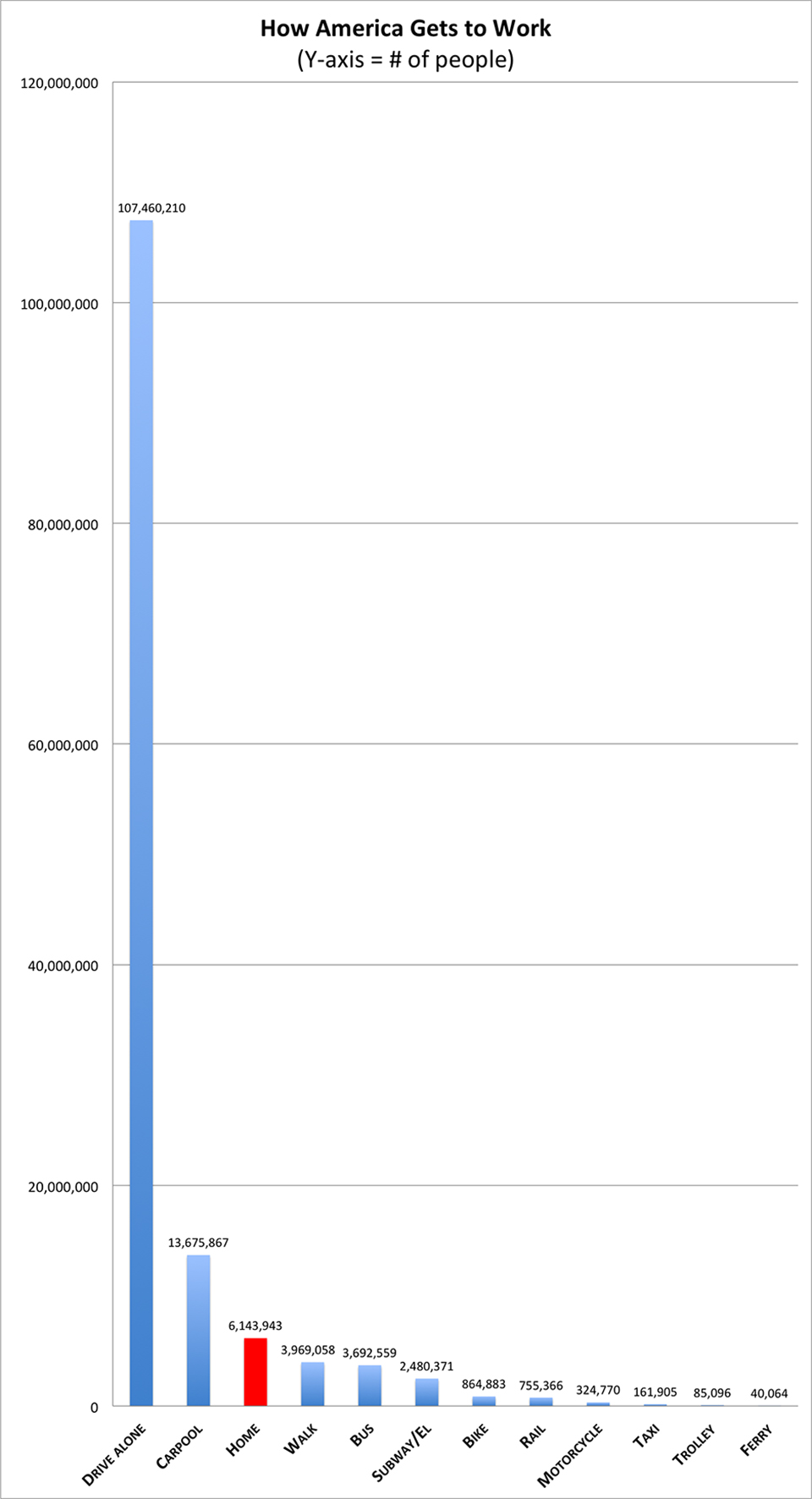
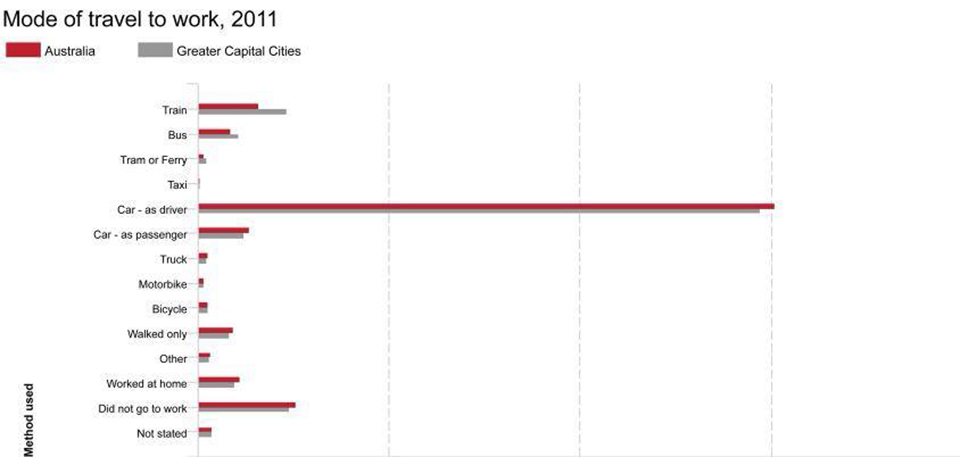
Although unable to find a chart specifically for Sydney and Perth, from the chart immediately above, we can see that Australia in general is similar to the U.S. in its automotive to public transit ratio. The U.S. has a population of 325M and a total of 250M vehicles, or 76% cars to humans of any age. Australia at a 23M population and 17M vehicles has a 74% cars to humans ratio.
The obvious fact, that is so well demonstrated here, is that in countries where people can afford cars, they will use them, despite the inconvenience of traffic congestion. The vast majority of workers want the freedom to go exactly where they want to go, exactly when they want to go, and to be able to secure things in their personal locker wherever they go.


“The significant problems we face cannot be solved by the same level of thinking that created them.”
“The formulation of the problem is often more essential than its solution, which may be
merely a matter of mathematical or experimental skill.”
“If I had an hour to solve a problem I'd spend 55 minutes thinking about the problem and 5
minutes thinking about solutions.”
― Albert Einstein